
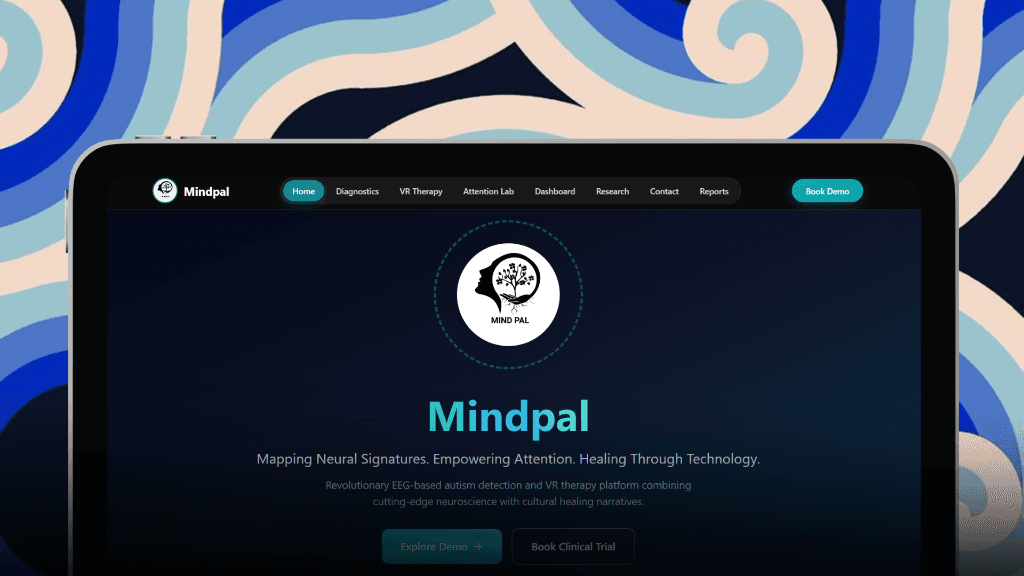
Mindpal
A comprehensive AI and IoT-powered solution for early Autism detection and therapy using EEG, VR, and auditory stimulation.
Timeline
Research ongoing
Role
Full Stack & Hardware Integration
Team
Research Team
Status
CompletedTechnology Stack
Mindpal: Future VR Tech Solution for Autism
Overview
Mindpal is a novel techno-management solution designed to address the lack of accessibility and objectivity in early Autism Spectrum Disorder (ASD) diagnosis. It integrates EEG sensors, Virtual Reality tasks, motion tracking, and auditory therapy to assess and support brain activity and sensory response patterns.
Features
- Objective ASD Detection: Uses EEG analysis to identify frontal asymmetry and neural biomarkers.
- VR-Based Therapy: Immersive custom scenes and AI-based gamification to enhance attention and relaxation.
- Auditory Stimulation: Integrated music therapy featuring specific Indian Ragas to regulate emotions and stress.
- Vestibular Stimulation: Targeted occipital nerve vibration for improved visual focus and calming effects.
- Real-time IoT Dashboard: A web-based platform for therapists to monitor patient progress and access diagnostic reports.
- AI Chatbot: A personalized assistant for preliminary behavioral observation and suggestion.
Why I built this
I built this project to bridge the critical gap where many children remain undiagnosed due to the high cost and subjectivity of traditional tools like ADOS or parental-biased questionnaires like M-CHAT. Mindpal empowers families and doctors with a low-cost, sensor-backed platform.
Technical Stuff
Hardware Integration
The system relies on a sophisticated hardware-software loop for accurate data collection:
- EEG Headset (Emotiv): For collecting real-time brainwave data.
- ESP32 + MPU6050: An accelerometer-gyroscope unit used for precise head tracking and measuring distraction levels.
- Vibration Actuators: Controlled motors placed near the occipital nerve for vestibular stimulation.
Signal Processing & AI
- Neural Metrics: Implemented log transformation, band-pass filtering, and ERP peak detection to extract amplitude and latency.
- Machine Learning: Utilized KNN and PCA (Principal Component Analysis) to classify ASD into three stages: Mild, Moderate, and Severe.
- Accuracy: The model achieves a weighted average accuracy of 0.94 across classification tasks.
Indian Raga Music Therapy
The auditory engine selects ragas based on health benefits and time of day to maximize therapeutic impact:
- Raga Darbari Kanada: Used late night for deep stress relief and calming the nervous system.
- Raga Todi: Used in the morning to increase alertness, memory, and concentration.
- Raga Yaman: Used in the evening to induce peacefulness and emotional balance.
Technical Challenges & Solutions
Challenge 1: EEG Data Complexity
- Problem: Raw EEG signals are noisy and difficult to translate into actionable stages.
- Solution: Developed a Mean EEG formula—to analyze average brain activity across critical sensors.
Challenge 2: Real-time Monitoring
- Problem: Therapists need remote access to patient data during home-based VR sessions.
- Solution: Integrated an IoT platform with MongoDB and Firestore to sync sensor data and VR performance metrics to a live Patient Dashboard.
Challenge 3: Diagnostic Subjectivity
- Problem: Standard behavioral observation can be subjective.
- Solution: Built an AI feedback engine with gamification that records objective interaction metrics (e.g., object sorting, memory games) alongside neural data.
Achievements
- 1st Runners-Up: ICYIM IET Kolkata Local Network.
- Innovation Award: Recognized as the "Most Innovative Project" at Hack Synthesis 2.0.
- Incubation: Supported by the Wadhwani Foundation and AICTE Ignite Programme.