
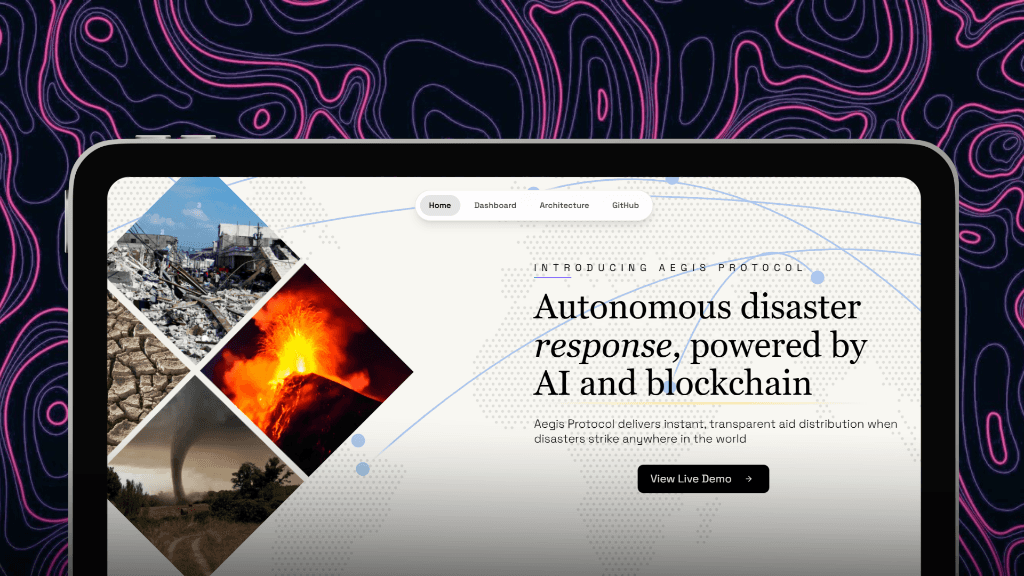
AEGIS Smart Protocol
A fully autonomous, multi-agent disaster response system designed to remove human bottlenecks from emergency aid. The protocol utilizes a three-stage pipeline (Detection → Verification → Disbursement) to analyze satellite/drone imagery in real-time and execute trustless cryptocurrency payments to relief organizations immediately upon verifying a disaster event.
Timeline
Role
Team
Cloud Chingri
Status
PrototypeTechnology Stack
AEGIS Smart Protocol
AI Agents Powering Trustless Disaster Relief
Overview
AEGIS Smart Protocol is a fully autonomous, multi-agent disaster response system designed to remove human bottlenecks from emergency aid. The protocol utilizes a three-stage pipeline (Detection → Verification → Disbursement) to analyze satellite/drone imagery in real-time and execute trustless cryptocurrency payments to relief organizations immediately upon verifying a disaster event.
The Problem
Traditional disaster relief systems suffer from:
- Slow Response Times: Manual verification and bureaucratic approval processes delay critical aid
- Lack of Transparency: Donors can't track where their money goes
- Human Bottlenecks: Relief organizations wait days or weeks for funding approval
- Fraud & Misallocation: No automated verification of actual disaster events
The Solution: Three AI Agents
1. Watchtower Agent
The eyes of the system. Runs parallel computer vision algorithms to detect disasters from raw aerial imagery:
- Fire Detection: HSV color space analysis for flame signatures
- Flood Detection: Water body expansion analysis
- Structural Damage: Edge detection for collapsed buildings
- Casualty Detection: Object detection for emergency scenarios
All detections require >60% confidence thresholds to proceed.
2. Auditor Agent
The brain of the system. Verifies events by:
- Cross-referencing multiple data sources
- Calculating "Human Impact Scores" based on population density
- Preventing false positives and fraud attempts
- Generating transparent audit trails
3. Treasurer Agent
The hands of the system. Autonomously manages an Ethereum wallet to:
- Sign and broadcast transactions to relief organizations
- Handle gas fee estimation and nonce management
- Execute payments without human intervention
- Maintain transaction records on-chain
Technical Architecture
Core Technologies
- Python 3.9+: Agent orchestration and logic
- OpenCV: Computer vision for disaster detection
- NumPy: Data analysis and scoring algorithms
- Redis: Message queuing between agents
Blockchain Layer
- Ethereum (Sepolia Testnet): Smart contract deployment
- Web3.py: Blockchain interaction
- Eth-account: Wallet management
- Infura RPC: Node connectivity
Infrastructure
- Docker: Containerized deployment
- Flask: REST API for frontend communication
- Heroku / AWS: Cloud hosting
Frontend
- Vanilla HTML/CSS/JS: Lightweight interface
- Neobrutalist UI Design: Bold, transparent design philosophy
Key Features
Real-time Detection
Processes satellite and drone imagery in real-time using parallel computer vision algorithms across four disaster categories.
Autonomous Verification
Multi-layered verification system that calculates human impact scores and cross-references data to prevent false positives.
Trustless Disbursement
Blockchain-based payment system that executes cryptocurrency transfers to verified relief organizations without human intervention.
Glass Box Transparency
Every decision made by the AI agents is logged and auditable, making the autonomous system transparent to donors and stakeholders.
Technical Challenges & Solutions
Challenge 1: Agent Orchestration
Problem: Coordinating three independent AI agents asynchronously. Solution: Implemented Redis message queuing to enable reliable inter-agent communication with retry logic.
Challenge 2: Fire Detection Accuracy
Problem: Distinguishing actual fire signatures from similar visual patterns (sunsets, red objects). Solution: Developed robust HSV color space analysis with multiple threshold checks and context-aware filtering.
Challenge 3: The Oracle Problem
Problem: Bridging off-chain computer vision data with on-chain financial execution. Solution: Created a trusted Auditor agent that acts as a verified oracle, cryptographically signing disaster confirmations.
Challenge 4: Gas Management
Problem: Managing testnet ETH liquidity and gas estimation during high-load scenarios. Solution: Implemented dynamic gas estimation with fallback mechanisms and transaction queue management.
Impact & Learnings
What I Learned
- DeFi Integration: Deep integration of Web3.py protocols with real-world physical data from OpenCV
- Transparent AI: Designing "Glass Box" interfaces that make autonomous AI decision-making auditable
- DevOps: Containerizing complex multi-service architectures (API + Workers + Redis) for consistent deployment
- Computer Vision: Advanced image processing techniques for disaster detection
Event
Built for Calcutta Hacks by team Cloud Chingri
Links
Status
Currently in Prototype stage with plans for mainnet deployment and integration with established relief organizations.